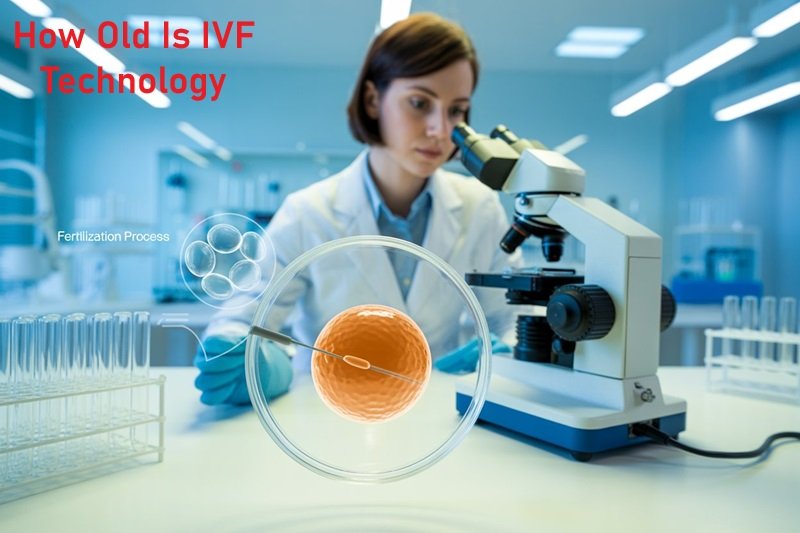
Introduction: How Old Is IVF Technology
In contemporary times, for a long time, In Vitro Fertilization (IVF) has ended up as one of the most vital breakthroughs in current medicine. Millions of couples internationally have fulfilled their dream of turning into parents through this superior reproductive generation. But a not-unusual query that many humans ask is, “How antique is IVF technology?”
The solution is charming. IVF isn’t always a quality modern-day medical fashion—it is the end result of a few years of scientific research, experiments, and breakthroughs. This article explores the entire data, timeline, improvement, fulfillment fees, and destiny of the IVF era in detail.
What Is IVF Technology?
In vitro fertilization (IVF) is a clinical manner in which an egg is fertilized via the usage of sperm outside the human body, in a laboratory setting. After fertilization, the embryo is transferred into the uterus to establish a pregnancy.
The time period “in vitro” method is “in glass,” referring to the lab manner in which fertilization takes place in a managed choice in the frame.
How Old Is IVF Technology?
IVF generation is over 45 years old nowadays.
The first successful IVF beginning occurred in 1978, making it one of the most modern inclinations in reproductive remedy to some degree within the 20th century.
The world’s first IVF infant, Louise Brown, was modified and born on July 25, 1978, in England. This ancient event marked the beginning of modern-day assisted reproductive generation.
Who Invented IVF?
The improvement of IVF is credited to two pioneering scientists:
- Robert Edwards – A physiologist who advanced the scientific basis of IVF
- Patrick Steptoe – A gynecologist who specialised in laparoscopy
Their collaboration induced the successful start of the number one IVF infant. Later, Robert Edwards was furnished the Nobel Prize in Physiology or Medicine in 2010 for his contribution.
Timeline of IVF Technology
Below is a detailed timeline displaying how IVF advanced over time:
| Year | Milestone |
|---|---|
| 1890s | Early experiments in animal fertilization begin |
| 1934 | First successful IVF experiment in rabbits |
| 1959 | First IVF birth in animals (rabbit) |
| 1978 | First human IVF baby born (Louise Brown) |
| 1981 | First IVF baby born in the United States |
| 1992 | Introduction of ICSI (Intracytoplasmic Sperm Injection) |
| 2000s | Improvements in embryo freezing and genetic testing |
| 2010 | Robert Edwards wins Nobel Prize |
| 2020s | AI and advanced embryo selection techniques emerge |
Early History of IVF (Before 1978)
Although IVF has come to be a success since 1978, its roots pass decrease, decrease, and lots further.
Early Scientific Experiments
Scientists began experimenting with fertilization outside the frame within the late 19th and early 20th centuries. These early tries were favored and performed on animals.
Animal Research Breakthroughs
- In 1959, researchers effectively fertilized rabbit eggs outside the frame.
- This take a look at proved that existence should begin in a laboratory environment.
These discoveries laid the foundation for human IVF.
The First IVF Baby: A Historic Moment
The birth of Louise Brown turned out to be a turning point in medical data.
Key Facts
- Born in Oldham, England
- Delivered through cesarean segment
- Completely healthy at delivery
Initially, the modified method met with skepticism and ethical worries. However, as extra success is born and discovered, IVF obtains splendor worldwide.
Evolution of IVF Technology
Since 1978, IVF has improved drastically. What began as a primary laboratory method has now come to be a significantly contemporary clinical treatment.
1. Improved Fertilization Techniques
Modern IVF uses superior strategies like
- ICSI (Intracytoplasmic Sperm Injection)
- Assisted hatching
- Blastocyst way of existence
2. Embryo Freezing (Cryopreservation)
Freezing embryos lets couples:
- Attempt pregnancy later
- Reduce fee of repeated cycles
- Increase fulfillment expenses
3. Genetic Testing
Preimplantation Genetic Testing (PGT) lets in the following:
- Detect genetic issues
- Improve probabilities of wholesome pregnancy
4. Use of AI in IVF
Artificial intelligence is now used to:
- Select the first-rate embryos
- Predict achievement fees
- Reduce human mistakes
How IVF Works: Step-via-Step Process
Understanding how IVF works can assist in offering an explanation for why it took a long time to note this period.
Step 1: Ovarian Stimulation
Hormones are given to stimulate the ovaries to supply multiple eggs.
Step 2: Egg Retrieval
Eggs are gathered from the ovaries using a minor surgical treatment.
Step 3: Fertilization
Eggs are mixed with sperm in a laboratory dish.
Step 4: Embryo Development
Fertilized eggs become embryos over numerous days.
Step 5: Embryo Transfer
A healthy embryo is transferred into the uterus.
Step 6: Pregnancy Test
After weeks, a being pregnant takes a look at the confirmed achievement.
IVF Success Rates Over Time
IVF success rates have improved dramatically over time.
| Decade | Success Rate |
|---|---|
| 1980s | 5–10% |
| 1990s | 15–20% |
| 2000s | 25–35% |
| 2010s | 40–50% |
| 2020s | 50%+ (depending on age and health) |
Factors Affecting IVF Success
Several elements have an impact on IVF success:
Age of the Woman
Younger ladies have higher fulfillment prices.
Egg Quality
Healthy eggs increase the possibility of fertilization.
Sperm Quality
Good sperm improves embryo formation.
Lifestyle Factors
- Smoking
- Alcohol
- Stress
Medical Conditions
Conditions like PCOS or endometriosis can also have an impact on fertility.
Advantages of IVF Technology
IVF offers several advantages:
- Helps infertile couples conceive
- Enables unmarried dad and moms and equal-intercourse couples
- Allows genetic screening
- Preserves fertility (egg freezing)
Challenges and Limitations of IVF
Despite its fulfillment, IVF has limitations:
High Cost
IVF can be expensive and is now not continuously protected through coverage.
Emotional Stress
Multiple cycles can be desired.
Health Risks
- Ovarian hyperstimulation syndrome (OHSS)
- Multiple pregnancies
Ethical Concerns
Some human beings have issues about embryo preference and disposal.
IVF in India: Growth and Accessibility
India has seen a rapid increase in IVF generation.
Key Highlights
- Affordable as compared to Western worldwide locations
- Advanced fertility clinics available
- Increasing recognition among couples
Cities like Delhi, Mumbai, and Lucknow now have cutting-edge IVF facilities supplying a world-class remedy.
Modern Innovations in IVF
Today, IVF is extra superior to ever before.
1. Frozen Embryo Transfer (FET)
Improves success charges by using the usage of preserved embryos.
2. Time-Lapse Imaging
Tracks embryo improvement in real-time.
3. Genetic Screening
Reduces hazard of inherited sicknesses.
4. Minimal Stimulation IVF
Uses fewer hormones, lowering facet results.
Future of IVF Technology
The destiny of IVF appears promising.
Possible Developments
- Artificial wombs
- Gene-enhancing technology
- Improved success expenses
- Lower treatment charges
Scientists are working to make IVF greater accessible and effective for all and sundry.
Interesting Facts About IVF
- Over 8 million infants had been born through IVF global
- IVF is applied in people and animals
- The first IVF little one is now determined to herself
- IVF success relies very closely on age
Frequently Asked Questions
1. How antique is the IVF era nowadays?
IVF technology is over 55 years old, starting from 1978.
2. Who invented IVF?
Robert Edwards and Patrick Steptoe evolved IVF.
3. Is IVF secure?
Yes, IVF is usually strong; however, it can also have some dangers.
4. How much of a hit is IVF?
Success charges range from 40 to 50% or better, counting on age and health.
Conclusion
So, how vintage is the IVF era? While the primary hit IVF beginning occurred in 1978, the adventure of IVF commenced many years in advance via clinical studies and experimentation. Today, IVF is greater than 45 years old and maintains to conform unexpectedly.