Introduction: How Much Water Does One AI Photo Use
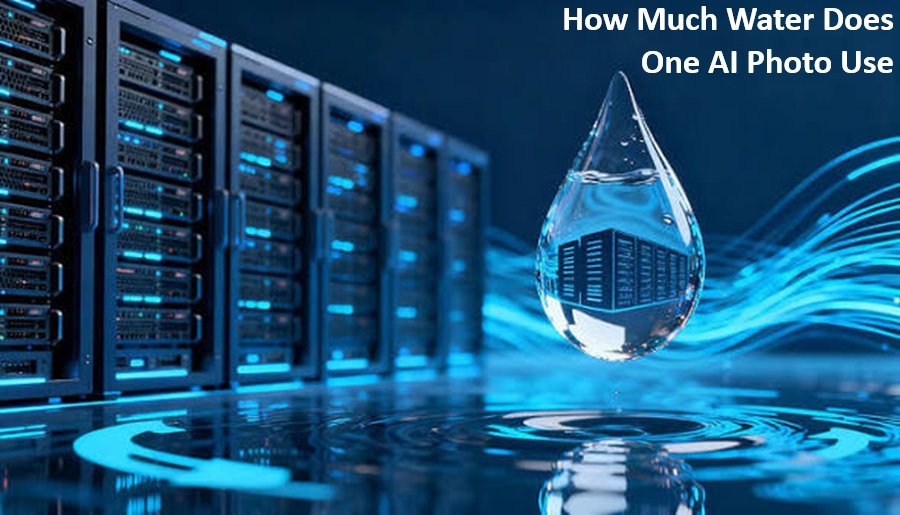
Artificial intelligence (AI) has changed the way people create and share digital content. Today, anyone can generate realistic photographs, illustrations, portraits, and creative designs simply by entering a text prompt into an AI image generator. Tools such as ChatGPT, DALL·E, Midjourney, and other AI platforms make image creation faster and easier than traditional photography or graphic design. How Much Water Does One AI Photo Use.
However, the growing popularity of AI-generated images has raised an important environmental question: How much water does one AI photo use?
Although an AI-generated photo is digital and does not require physical printing, creating it involves powerful computer systems running inside data centers. These facilities consume electricity and may use water to cool their equipment. Water can also be consumed indirectly when electricity is generated.
There is no single confirmed water-use figure for every AI-generated image. The amount depends on the AI model, data center, cooling technology, electricity source, image resolution, and number of generation attempts. Understanding these factors helps explain the environmental cost of creating AI photos.
How Much Water Does One AI Photo Use?
A useful estimate from a 2026 report by the United Nations University Institute for Water, Environment and Health (UNU-INWEH) puts the water footprint of a standard-resolution AI-generated image at approximately 28.6 millilitres of water.
This is an estimated environmental footprint, not a direct measurement of every image generated by every AI platform. Actual consumption can be lower or higher depending on the technology and data center conditions. domingogallardo.github.io
To understand this amount, 28.6 millilitres is approximately:
- A little less than two tablespoons of water.
- A small fraction of a standard drinking glass.
- Approximately 0.029 litres of water.
The number may seem small for one image, but the total impact becomes more significant when millions of people generate AI images every day.
Estimated Water Consumption of AI Photos
The following table uses the approximate 28.6 ml estimate to illustrate how water consumption can add up.
| Number of AI photos | Estimated water consumption |
|---|---|
| 1 AI photo | 28.6 ml |
| 5 AI photos | 143 ml |
| 10 AI photos | 286 ml |
| 20 AI photos | 572 ml |
| 50 AI photos | 1.43 litres |
| 100 AI photos | 2.86 litres |
| 500 AI photos | 14.3 litres |
| 1,000 AI photos | 28.6 litres |
Note: These figures are mathematical estimates based on the same 28.6 ml assumption. They are not guaranteed measurements for individual AI tools.
Why Does Generating an AI Photo Use Water?
Many people believe that generating a digital photo requires no physical resources. While the final image exists as a digital file, the computers responsible for creating it need electricity and cooling.
AI image generators use powerful processors, including graphics processing units (GPUs), to perform complex calculations. These calculations produce heat, and data centers must manage that heat to keep their equipment operating safely.
There are several reasons why AI image generation is associated with water consumption.
1. Data Center Cooling Systems
Data centers contain thousands of servers that process information and perform AI calculations. When these servers operate continuously, they produce considerable heat.
Some facilities use water-based cooling systems to control temperatures. In evaporative cooling systems, water absorbs heat and evaporates, helping cool the surrounding equipment.
This process can consume water even though users never see or interact with the cooling system. Other data centers use air cooling, closed-loop liquid cooling, or alternative technologies that can reduce direct water consumption. The cooling method makes a significant difference to the overall environmental footprint. UC Berkeley Law+1
2. Electricity Generation
AI image generation also requires electricity. Data centers need power to operate GPUs, servers, storage systems, networking equipment, and cooling infrastructure. However, electricity production can also require water. Some power plants use water for cooling, while other energy sources have different water requirements throughout their production processes.
This means that an AI photo can have an indirect water footprint even if the data center itself uses very little water. The electricity source, local energy infrastructure, and data center efficiency all influence this impact.
3. Powerful GPUs and AI Processors
AI image generators use specialized computer hardware to transform text descriptions into visual content.
For example, when someone enters a prompt asking for a realistic photograph of a mountain landscape, the AI model performs multiple calculations before producing the final result.
These calculations require computing power and electricity. More computational work can increase heat production and cooling requirements.
However, the water footprint is not determined by GPU power alone. Hardware efficiency, processing time, and cooling infrastructure also matter.
4. Repeated Image Generation
Many users do not stop after generating one image. They may create several versions before finding a result they like.
For example, a person might generate ten images to select one suitable profile picture. If each image had the estimated 28.6 ml footprint, the combined estimated water consumption would be 286 ml.
Repeated attempts can therefore increase the total environmental impact of AI image creation.
Does Every AI Image Generator Use the Same Amount of Water?
No. Different AI image generators can have different water footprints.
Some platforms use larger AI models that require more computing resources. Others use optimized models designed to generate images with less processing power.
The following factors can change the amount of water associated with an AI-generated photo.
| Factor | How it affects water consumption |
|---|---|
| AI model size | Larger or more computationally demanding models may require more energy |
| Image resolution | High-resolution images can require additional processing |
| GPU efficiency | Efficient processors can reduce electricity requirements |
| Cooling technology | Water-based cooling may consume more direct water than some air-based systems |
| Electricity source | Different power sources have different indirect water footprints |
| Data center location | Local climate and water availability influence cooling requirements |
| Number of attempts | Generating more images increases total resource consumption |
Research comparing 17 image-generation models has found substantial differences in their energy requirements. The study reported up to a 46-fold difference between some tested models. It also found that increasing image resolution can increase energy consumption, although the effect varies by model. arXiv
This research demonstrates why it is difficult to assign one universal water-consumption number to every AI-generated photo.
How Does AI Image Generation Affect the Environment?
AI image generation offers many creative benefits, but its environmental impact deserves attention. The technology depends on large computing infrastructures, and these facilities require electricity, cooling, and physical resources.
Here are some important environmental considerations.
1. Freshwater Consumption
Freshwater is an important resource for households, agriculture, industries, and ecosystems.
When data centers use freshwater for cooling, they can increase pressure on local water supplies, particularly in regions experiencing water shortages.
The impact depends on how much water a facility consumes and where it operates. A data center located in a water-stressed region may create greater local concerns than a similar facility in an area with abundant water resources.
2. Increasing Demand for Data Centers
The popularity of artificial intelligence is encouraging companies to expand their data center infrastructure.
More servers and computing equipment can increase demand for electricity and cooling.
According to Rystad Energy’s September 2026 analysis, global data center water consumption could reach approximately 644 billion litres annually by 2030 without additional water-saving measures. Its more optimistic scenario estimates approximately 388 billion litres with active mitigation. These are projections rather than confirmed future consumption figures. Rystad Energy
3. Electricity and Carbon Emissions
Generating AI images requires electricity, and electricity production can contribute to greenhouse gas emissions depending on the energy source.
Facilities powered by cleaner energy can reduce some environmental impacts. Improving server efficiency and reducing unnecessary computing also help.
4. Pressure on Local Water Resources
Water consumption is not only a global environmental issue. It can also affect nearby communities.
If a large data center uses significant amounts of local freshwater, it may increase competition for water among businesses, residents, and agricultural activities.
Responsible water management is therefore important when companies choose locations for new data centers.
How Much Water Do 10, 100, and 1,000 AI Photos Use?
The approximate 28.6 ml estimate makes it easier to understand the combined water footprint of multiple images.
Consider three examples:
10 AI photos: Generating ten images would represent approximately 286 ml of water consumption using the estimated figure.
100 AI photos: Creating 100 images would represent approximately 2.86 litres.
1,000 AI photos: Generating 1,000 images would represent approximately 28.6 litres.
These examples show how small individual estimates can become more meaningful when AI image generation takes place at a large scale.
However, these calculations should not be interpreted as exact measurements. Real-world water consumption varies between providers, models, facilities, and electricity systems.
Is AI Image Generation More Water-Intensive Than Traditional Photography?
It is difficult to make a direct comparison because traditional photography and AI image generation use resources differently.
Traditional photography can involve cameras, lighting equipment, computers, editing software, transportation, and physical printing. Each activity has its own environmental footprint.
AI-generated photography does not require a physical camera or a photographer to capture the particular scene. However, it relies on data centers, computer hardware, and electricity.
The comparison also depends on what is being measured.
For example, comparing one AI-generated digital image with one professionally photographed and printed photograph would not be a fair comparison unless both processes were assessed using the same environmental boundaries.
| Category | AI-generated photo | Traditional photography |
|---|---|---|
| Image creation | AI model and computing systems | Camera and photographic equipment |
| Electricity | Required for AI processing | Required for cameras, lighting, and editing |
| Water footprint | Mainly associated with computing infrastructure and electricity | Associated with equipment production, printing, and other activities |
| Physical materials | Digital storage and computing hardware | Cameras, accessories, paper, and printing materials |
| Editing | AI processing and software | Editing software and computer systems |
| Environmental impact | Depends on AI model and data center | Depends on photography method and production process |
Neither method is automatically environmentally friendly in every situation. A complete comparison requires measuring the entire process rather than considering only the final image.
How Can You Reduce the Water Footprint of AI Image Generation?
You do not need to stop using AI image generators to make more environmentally responsible choices. Small changes in how you use these tools can help reduce unnecessary computing.
Here are some practical suggestions.
1. Avoid Unnecessary Image Generation
Before generating an image, think about what you actually need.
Instead of creating dozens of random images, prepare a clear description of the image you want. This can help reduce repeated attempts.
2. Use Appropriate Image Resolution
Not every project requires an extremely high-resolution image.
For a small website thumbnail or social media post, a standard-resolution image may be sufficient.
Higher resolutions can require additional computing resources, depending on the model and generation process.
3. Choose Efficient AI Tools
Some AI image generators use optimized models and efficient computing infrastructure.
When environmental information is available, consider providers that publish transparent details about their energy consumption, water use, and sustainability practices.
4. Avoid Repeated Experiments
Generating multiple images without a clear purpose can increase resource consumption.
Plan your prompts carefully and make small adjustments when necessary instead of starting completely new generations every time.
5. Support Sustainable Technology
Companies can improve the environmental performance of AI by investing in efficient hardware, renewable electricity, water recycling, and alternative cooling technologies.
Users can also encourage greater transparency by supporting services that provide meaningful environmental information.
What Are AI Companies Doing to Reduce Water Consumption?
Technology companies are increasingly examining the environmental impact of their AI infrastructure.
Several approaches can help reduce water consumption.
- Advanced cooling systems: Companies can use efficient cooling technologies that reduce dependence on freshwater.
- Recycled water: Some data centers use reclaimed or recycled water instead of relying entirely on drinking water.
- Renewable energy: Solar and wind energy can help reduce certain indirect environmental impacts associated with electricity production.
- Efficient AI models: Optimized models can complete image-generation tasks using fewer computing resources.
- Water monitoring: Measuring water usage helps companies identify inefficiencies and improve resource management.
Google, for example, has published research explaining how it measures the energy, emissions, and water impact of AI services. Its 2025 report estimated that a median Gemini text prompt consumed 0.26 ml of water. However, this figure relates to text generation, not AI image generation, so it should not be treated as an image-generation estimate. Google Cloud Blog
Transparency is important because users need reliable information to understand the environmental costs of different AI services.
Important Facts About AI Photo Water Consumption
| Question | Answer |
|---|---|
| How much water does one AI photo use? | One 2026 report estimates approximately 28.6 ml for a standard-resolution image |
| Is this figure exact? | No, it is an estimate based on environmental benchmarks |
| Why does AI use water? | Mainly through data center cooling and electricity generation |
| Does every AI tool use the same amount? | No, consumption varies by model and infrastructure |
| Do high-resolution images use more resources? | They can require additional processing |
| Does generating multiple images increase consumption? | Yes, overall resource use generally increases |
| Can AI generate images without direct water cooling? | Yes, some facilities use air cooling or other systems |
| Can users reduce AI water consumption? | Yes, by avoiding unnecessary generations and choosing efficient tools |
Frequently Asked Questions (FAQs)
1. How much water does one AI photo use?
A 2026 UNU-INWEH report estimates that a standard-resolution AI-generated image has a water footprint of approximately 28.6 millilitres. The actual amount varies depending on the AI model, data center, cooling system, and electricity source.
2. Does ChatGPT use water to generate images?
ChatGPT image generation requires computing resources in data centers. These facilities may consume water through cooling systems and electricity generation. However, there is no publicly established universal water-consumption figure for every image generated through ChatGPT.
3. Why do AI-generated photos need water?
AI-generated photos require powerful computer processors. These processors produce heat while performing calculations. Some data centers use water-based cooling systems to manage this heat, creating a direct water footprint.
4. Does generating 100 AI photos use a lot of water?
Using the estimated figure of 28.6 ml per image, generating 100 AI photos would represent approximately 2.86 litres of water. This is an illustrative calculation rather than a guaranteed measurement.
5. Do free AI image generators also consume water?
Yes. Free AI image generators still operate using computer infrastructure. Even when users do not pay for the service, the servers and supporting systems require electricity and cooling.
6. Are AI-generated images harmful to the environment?
AI-generated images have an environmental footprint because they require computing power, electricity, and supporting infrastructure. However, the impact varies depending on the technology and how efficiently it operates.
7. Can AI image generation work without water?
AI image generation can operate in data centers that do not rely on direct water-based cooling. However, indirect water consumption may still occur through electricity generation and other parts of the technology supply chain.
8. Does generating a high-quality AI photo use more water?
It can. High-resolution images and more computationally demanding generation processes may require additional energy. However, the exact difference depends on the AI model and its optimization.
Conclusion
So, how much water does one AI photo use? A 2026 UNU-INWEH report provides an approximate estimate of 28.6 millilitres per standard-resolution AI-generated image. However, this is not a universal measurement, and actual water consumption can vary considerably.